Most people spend about 90% of their time indoors, so indoor particle levels can strongly influence total exposure. Air fresheners can make rooms smell pleasant, they only mask odours, they dont clean the air. When air fresheners are sprayed or evaporate, they release volatile organic compounds (VOCs) into the air. These VOC’s can react with ozone in indoor air to create secondary pollutants, including small particles similar to PM2.5.
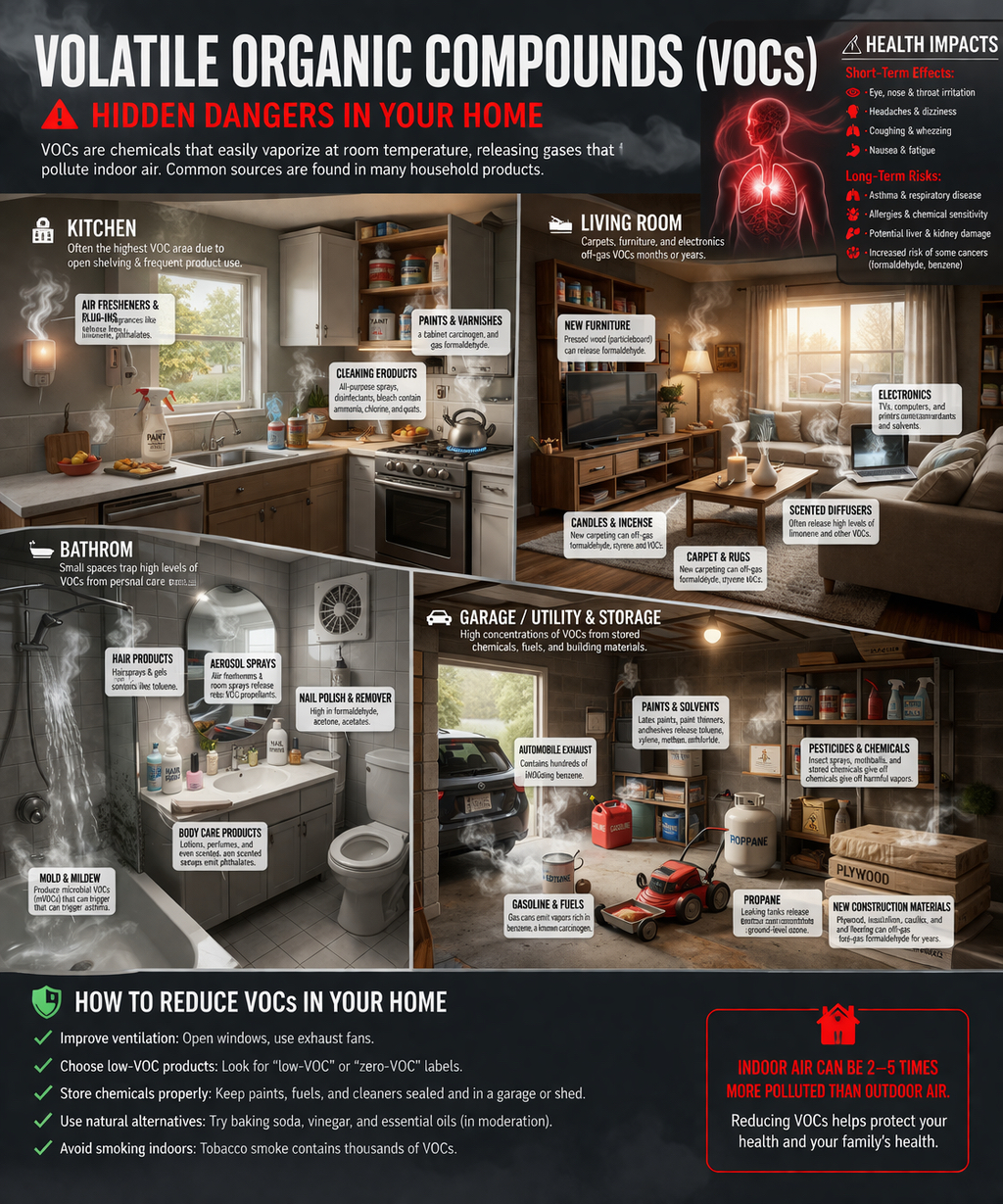
- Kitchen – Air Freshner, plug-ins, Cleaning products
- Living Room – Candles and Incense, Scented Diffusers,
- Bathroom – Hair products, gels, body care products, nail polish.
- Garage – Pesticides, construction materails, paints, solvents.
VOC’s – Volatile organic compounds
Common VOC’s include:
- Limonene – Biggest issue is not the ingedient itself, but what it reacts with indoors. If it reacts with ozone air, it can produce formaldehyde or particles similar to PM2.5
- Benzene – This is a well established Carcinogen, its a Group 1 carcinogen, this means there is very strong scientific evidence that it can cause cancer in humans. Benzene affects the bone marrow where blood cells are produced.
- Formaldehyde – The International Agency for Research on Cancer classifies formaldehyde as carcinogenic to humans (Group 1), meaning there is strong evidence it can cause cancer with sufficient exposure.
PM2.5
PM2.5 stands for particulate matter that is 2.5 micrometers (µm) or smaller in diameter. Because the particles are extremely small, they can:
- travel deep into the lungs
- enter the bloodstream
- trigger inflammation throughout the body
Long-term exposure is linked to diseases such as:
- Heart disease
- Stroke
- Chronic obstructive pulmonary disease
- lung cancer
Air pollution particles are estimated to contribute to millions of deaths worldwide each year.
Household activities that generate fine particles include:
1. Cooking
- Frying and Grilling food
2. Burning things
- candles
- incense
- Wood Burning